Never Satisfied: The Spirit That Builds Our Parts
Innovation is not a department. It is a temperament — a refusal to believe that any component, anywhere, is as good as it can be.
8 min read
Every industry, given enough time, falls asleep.
The signs are always the same. Designs stop changing because "that is how it has always been made." Specifications are copied from last year's drawing, which was copied from the year before. Materials are chosen from habit. Tolerances settle at whatever the market has learned to accept. The parts still work — that is the anaesthetic — and so an entire category can drift for a decade without anyone noticing that nothing has actually improved.
The motorcycle components industry is as vulnerable to this sleep as any other. Most of what fills the world's parts shelves today is, in engineering terms, a photocopy of a photocopy: adequate, familiar, unexamined.
We built this company to be the thing that does not fall asleep.
That is the honest definition of our innovation strategy — not a technology roadmap, though we have one, but a temperament that runs through every desk and every decision: the standing assumption that the current version of everything is merely the current version. Every part in our catalogue, every process behind it, every "settled" convention in this industry is treated as an open question. Some questions, when pushed, yield revolutions. Most yield a percent here, a micron there. We take both, endlessly, because that is what the spirit demands.
Restlessness, applied to physics
A restless temperament without technical depth is just noise. What turns ours into engineering is where we aim it: at the frontiers other industries have already opened, and this one has been slow to enter.
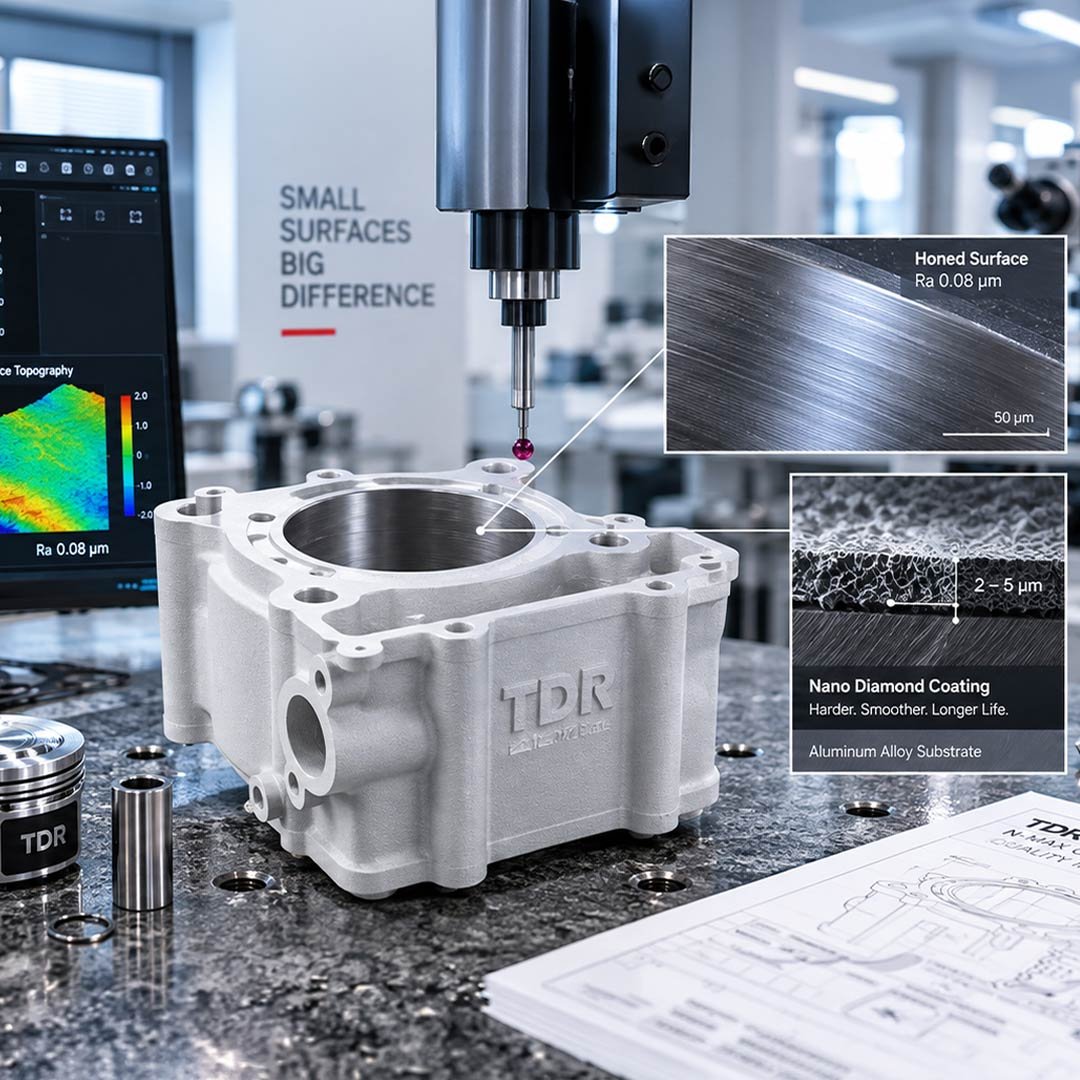
We aim it at surfaces. For a century, performance in this industry came from geometry — bore, stroke, lift, compression. That well still gives, but the deeper reserves now lie in a domain invisible to the eye: the first few microns where components actually meet. Tribology — the science of friction, wear, and lubrication — teaches that an engine's losses are decided in boundary layers measured in thousandths of a millimetre. So we invest where the physics points: advanced surface technologies, with nanodiamond-enhanced coatings as the flagship — diamond nanoparticles, among the hardest and most thermally conductive substances known, engineered into component surfaces to cut friction, raise hardness by an order of magnitude over the base metal, and move heat away from the exact contact points where engines suffer. A component treated this way is not the same part with a finish. It is a different material system — substrate and engineered surface, each doing what the other cannot. Same geometry, different physics.
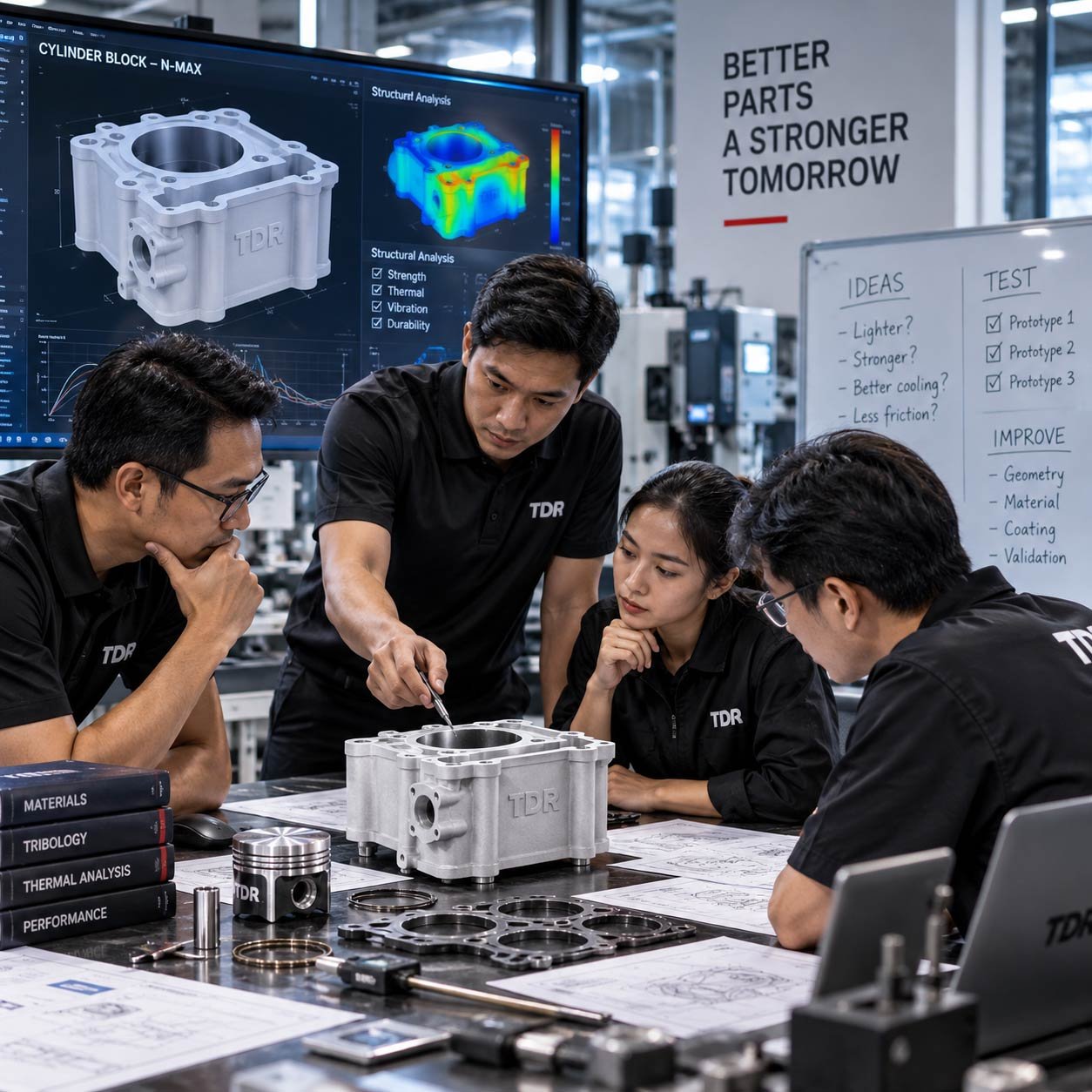
We aim it at computation. The industry's traditional method — build, test, break, adjust, repeat — is honest but slow, and it explores only the tiny corner of the design space a workshop has time to reach. We build the part twice: first in mathematics, then in metal. A drivetrain's interacting masses, spring rates, ramp angles, and thermal behaviour can be swept as a computational design space — thousands of configurations evaluated before one is manufactured. A cam profile is developed as a mathematical object, its lift, velocity, acceleration, and jerk curves shaped digitally against the resonant behaviour of the valvetrain that must follow it, because at sustained high RPM a valvetrain is less a mechanism than a vibration problem, and vibration problems are solved in the frequency domain, not on the bench. The prototypes that finally reach our rigs arrive near-optimal, because the thousand inferior versions were eliminated in silicon.
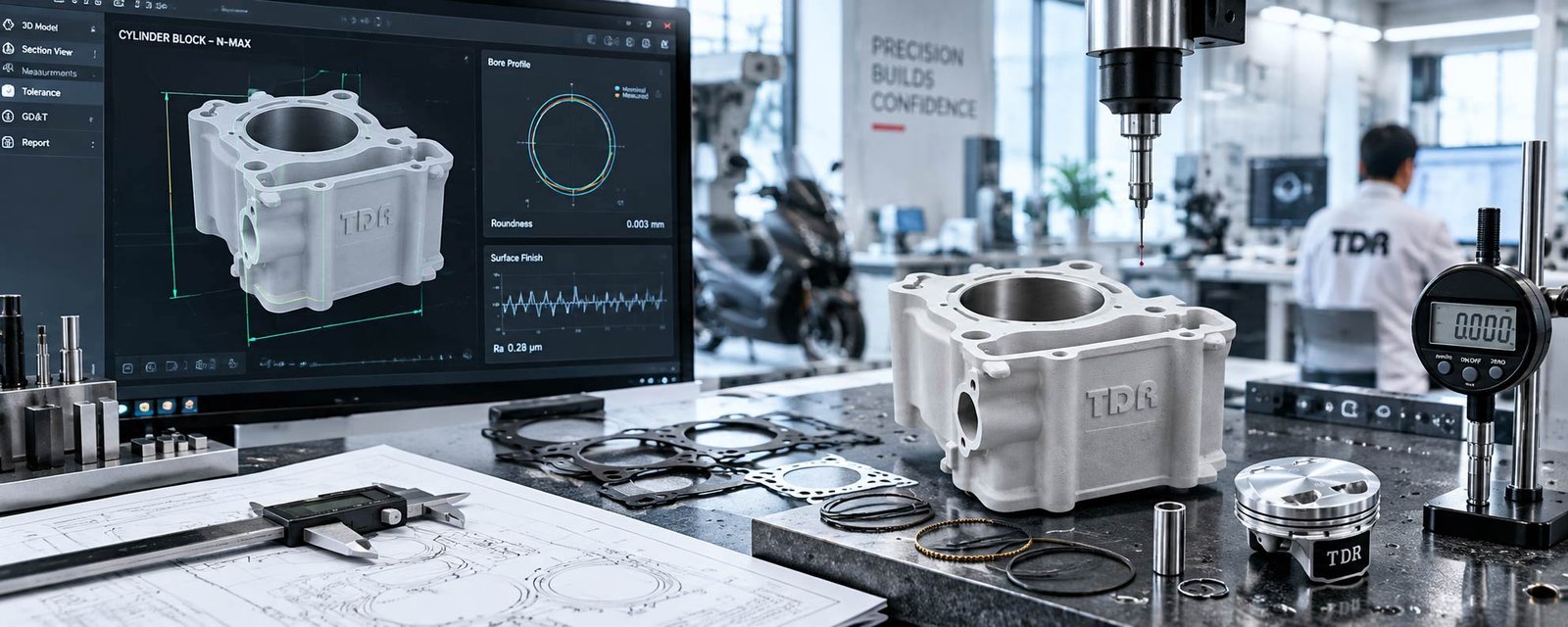
We aim it at measurement. The least glamorous frontier is the most decisive: an advanced design is worthless if you cannot prove, in the metal, that you achieved it. So metrology is its own technology stack here — coordinate measurement confirming geometry in three dimensions, profile tracing validating that a manufactured cam matches its mathematical parent, hardness and microstructure analysis proving that a coating or heat-treatment did in the material what it promised on the certificate. In an industry where a convincing-looking part can be made for a fraction of the cost of a correct one, the instruments are the honesty. A component is right when the numbers say it is right, and no earlier.
And we aim it at data. Every machine running our components is an endurance experiment in conditions no laboratory fully replicates — extreme heat, brutal duty cycles, load and fuel at the statistical edges. Wear patterns and longevity data flowing back from the field feed the next simulation, the next surface formulation, the next tolerance decision. The loop closes; iteration compounds. The tenth generation of a component carries lessons its first generation could not have known — and the gap between us and anyone still photocopying widens every cycle.
Innovation beyond the part
The same temperament refuses to stop at the product's edge, because a company is itself a machine, and machines can be engineered.
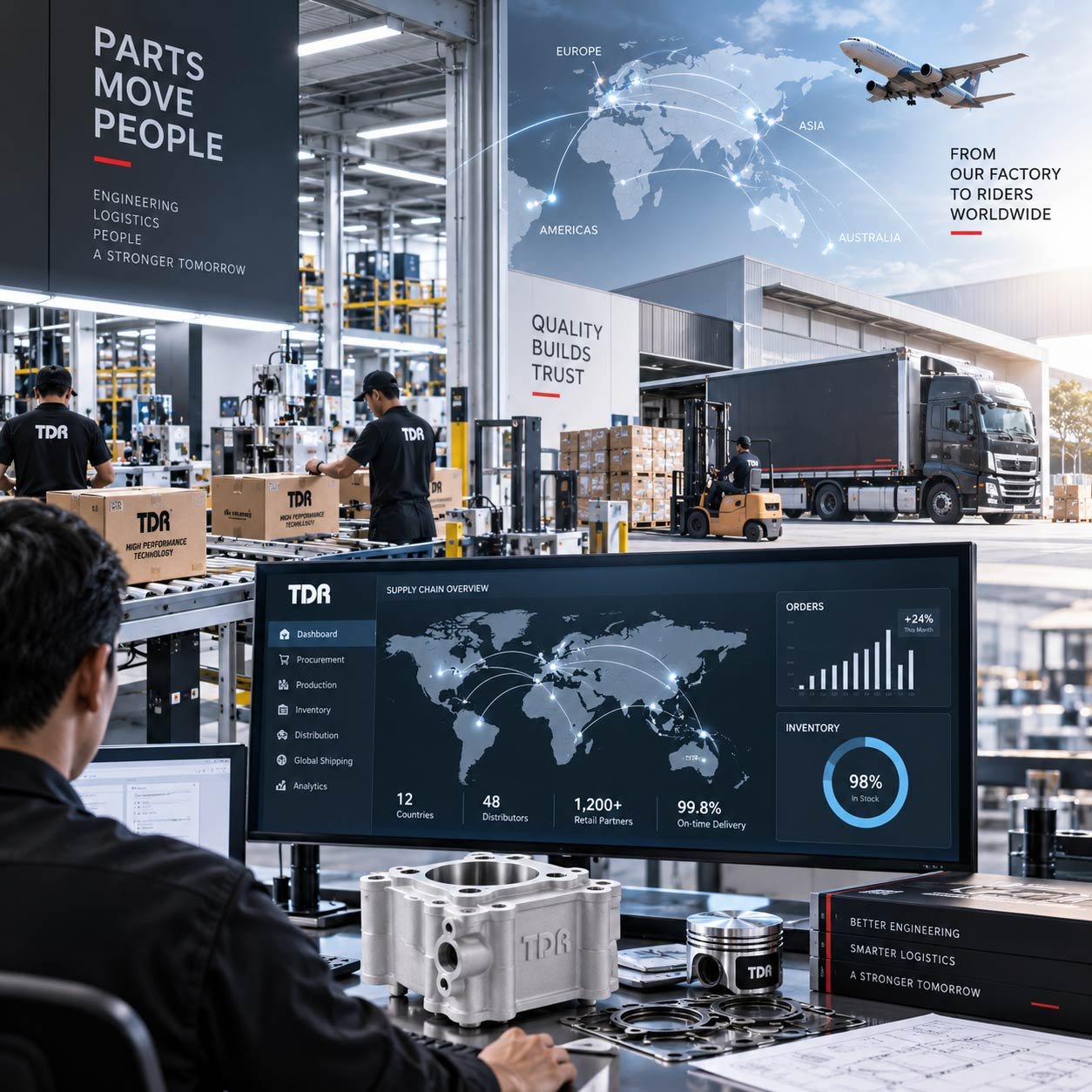
The systems that move our parts through the world — the digital infrastructure running procurement, inventory, finance, and distribution across borders and currencies — are built in-house, iterated with the same restlessness as a cam profile, and for the same reason: speed and precision compound wherever you install them. An innovation that reaches the market six months late has forfeited half its value. An organisation that senses demand faster, decides faster, and corrects faster is running a technology advantage just as real as anything under a valve cover. We treat our own operating system as a product in permanent development, because it is.
The spirit, stated plainly
Strip everything above to its core and what remains is a disposition — one we screen for, hire for, and protect:
Assume it can be better. Prove it with physics. Verify it with instruments. Feed what you learn back in. Then start again.
There is no finish line in that sentence, and that is deliberate. Companies that treat innovation as a project complete the project and stop. Companies that treat it as a temperament never get to stop — the current catalogue is simply the newest draft, the current process the newest baseline, the current best merely the thing tomorrow is obligated to beat.
The industry will keep producing photocopies. It always has; sleep is comfortable.
We will keep asking the only question that has ever moved a technology forward, aimed at everything we make and everything we are:
Why is this not better yet?